Every minute a trailer sits at the dock, money is tied up in inventory, labor, and yard capacity. A well-designed truck unloading conveyor turns dwell time into velocity by pulling cartons, parcels, and totes straight from vehicle to flow line with minimal manual handling. For parcel hubs, e-commerce fulfillment centers, cross-border logistics providers, and manufacturers receiving inbound components, the right conveyor at the door is often the difference between a smooth shift and a costly backlog.
Manual unloading is inconsistent, hard on teams, and vulnerable to volume spikes. By contrast, a purpose-built conveyor brings repeatability to the dock: it sets a steady takt rate, improves ergonomics, reduces touches, and captures data you can act on. Whether you run a high-paced express network, a growing 3PL in a free trade zone, or a regional distribution center feeding retail stores, a modern, modular conveyor architecture helps you scale throughput without simply adding headcount.
How a Truck Unloading Conveyor Works—and Why It Outperforms Manual Unloading
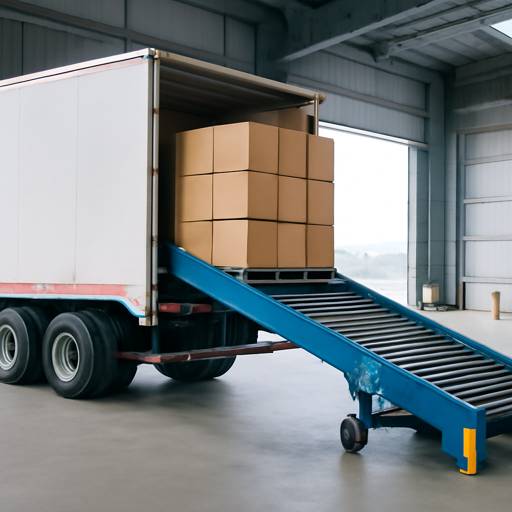
A truck unloading conveyor is a powered pathway that extends into a vehicle so cartons ride out of the trailer and into your facility. Most systems center on a telescopic or flexible section designed to reach deep into 40–53 ft containers while keeping operators in ergonomic positions. At the heart is a belt or roller surface driven by efficient motors and governed by variable-speed drives. Operators control the pace with convenient handles or pendant controls, nudging the line faster during light flows and slowing when downstream workstations need to breathe.
Telescopic belt conveyors use a series of sliding booms to bridge the gap from dock edge to trailer nose. They’re ideal for parcels, polybags, small boxes, and mixed SKUs because a belt supports even low-friction packages. Flexible, powered roller conveyors excel with uniform cartons and totes: rollers reduce friction and allow accumulation zones with photo-eyes and smart logic that keep gaps consistent and prevent pileups. Many docks deploy a hybrid—telescopic at the trailer interface feeding a flexible or fixed line that curves around columns and feeds induction points, sorters, or put-walls.
Thoughtful design multiplies performance. LED lighting illuminates trailer interiors; side guides and toe guards improve safety; soft-start drives prevent package surges; and reversible modes allow quick clearing of jams. Integrated scanners, dimensioning, and checkweighing stations can be placed just past the boom to capture data the moment freight hits your floor, enabling instant quality checks and precise inventory updates in WMS/WCS. With the right setup, you standardize a repeatable unload sequence: drop dock plate, extend boom, verify sensors, scan, and flow. The result is a predictable rate—often doubling or tripling manual unload speeds—along with fewer touches and dramatically lower strain injuries.
For operations exploring an upgrade or expansion, browsing a focused product lineup helps frame decisions about reach, width, speed, and controls. A curated range of solutions under the umbrella of truck unloading conveyor provides a practical starting point for matching technologies to package mix and facility layout without over-specifying or underbuilding the dock interface.
Choosing the Right Specification: Belt vs. Roller, Telescopic vs. Flexible, and the Details That Matter
Selecting the optimal conveyor is less about picking a single machine and more about configuring a system for your receiving profile. Start with the package mix. If you handle sacks, jiffy bags, and small cartons, a telescopic belt conveyor shines because the continuous surface supports irregular items that might stall on rollers. If freight is mostly rigid cartons and totes, powered roller sections provide gentle accumulation, zone control, and energy savings. Gravity roller extensions seem attractive for their simplicity, but they shift strain to operators when volumes surge; powered lines are more ergonomic and consistent.
Next, evaluate reach and height. Standard booms cover 10–16 meters (roughly 33–52 feet) of extension with elevation adjustments to match various dock heights and trailer floors. If you frequently unload pantechnicons or high-cube containers, verify the range of vertical travel and consider tilt or hydraulic lift assistance. Width should match your largest carton dimension plus safe clearances; common belt widths span 600–1000 mm. Speed typically ranges from 10 to 40 meters per minute; aim for adjustability so you can balance scan accuracy and downstream capacity with maximum truck turns per hour.
Controls and safety are nonnegotiable. Look for e-stops at operator points, pull cords, soft edges, and anti-collision sensors. Zone-based logic with photo-eyes keeps flow smooth and prevents cascade jams. If you operate in variable climates, check IP ratings and select belts with the right cover compound for temperature and abrasion. Noise levels matter too; low-dB motors and well-damped frames improve worker comfort and compliance. For compliance frameworks, confirm CE/UKCA/UL marks where applicable, along with guarding that meets local codes.
Integration bridges hardware and productivity. Seamless handoff to sortation, robotic depalletizing, or AMRs at the end of the line turns your conveyor into a synchronized cell. Add scanning arches and inline DWS to get instant ASN validation or cross-border documentation accuracy. Connect PLC data points—run time, jam counts, start/stop cycles—to your WCS for real-time dashboards that expose bottlenecks. Maintenance is equally strategic: specify automatic belt tracking, easy-access panels, and standardized spare parts (belts, photo-eyes, rollers, VFDs) to cut downtime. Build a preventive calendar around cleaning, belt tension checks, sensor alignment, and lubrication. A modest stock of wear parts plus remote diagnostic support can be the difference between a quick fix and a lost shift.
Finally, calculate ROI with conservative assumptions. Suppose a team unloads a 53-foot trailer in 90 minutes manually. With a well-chosen truck unloading conveyor, you may reduce that to 35–45 minutes, saving 40–60% in dock time. Multiply by trailers per day, add injury reduction, and factor decreased damage and better scan compliance. Most operations see payback in 6–18 months—faster in peak-heavy networks—especially when the conveyor allows reassigning labor to higher-value tasks like quality control or exception handling.
Real-World Use Cases, Layout Tips, and Best Practices from High-Throughput Docks
Express parcel hubs thrive on throughput. During peak season, trailers queue rapidly and every inbound door needs to clear at a predictable rate. A telescopic belt conveyor with 12–14 meters of reach, adjustable elevation, and bright interior lighting can stabilize unloads at 1,800–2,400 pieces per hour per door for mixed parcels. Coupled with a short powered roller spur feeding a scanning and weigh station, the system ensures 100% data capture before parcels hit the main sort. The predictable takt frees planners to schedule labor by volume rather than guesswork, while dock supervisors see live KPIs on doors running above or below target.
Cross-border logistics providers juggle cartons of varied sizes, taped bags, and return merchandise. Flexibility is paramount. A hybrid configuration—telescopic at the trailer and a flexible, powered roller snake that curves into a staging zone—allows teams to steer flow toward different induction points as customs or inspection lines change. In one example, a coastal 3PL receiving daily container loads from overseas vendors cut unload time from 70 minutes to 40 per box while improving data accuracy with inline scanning. The payoff wasn’t just labor time: improved tracing on inbound parcels reduced exceptions that previously delayed consolidation for export legs.
Manufacturers benefit too. Inbound components often arrive in totes and cartons. A truck unloading conveyor feeding directly into kanban lanes or an AS/RS induction point reduces touches and prevents line stoppages linked to late material. With PLC signals synced to the plant’s MES, gate times and line-side inventory become more reliable. Even without full automation, staging totes on powered lines with accumulation zones protects delicate parts from damage when downstream operators pause work to resolve a quality alert.
When designing the dock, think of flow, not just hardware. Align the conveyor’s end-of-boom with a clear “golden zone” where operators don’t twist or overreach. Keep scanners and monitors at eye level, and mount controls on both sides so left- or right-handed users remain comfortable. Provide visual cues—lane markings, andon lights for fault states—and ensure the conveyor’s shadow doesn’t impede label readability. Pair with dock levelers and vehicle restraints to standardize trailer alignment. If you anticipate dual unload (two operators in the same trailer), specify wider belts or parallel lines and standardize load sequencing from nose to tail to avoid congestion.
Operational discipline protects ROI. Start shifts with a quick pre-op checklist: confirm e-stops function, inspect belts for debris, test photo-eyes, verify lighting, and review target unload rates. Track KPIs that matter: unload time per trailer, pieces per labor hour, first-pass scan rate, exception count, and jam frequency by hour. Use the data to spot patterns—perhaps a specific supplier ships awkwardly sized cartons every Monday that warrant a slower speed profile or a dedicated lane. Over time, simple refinements—speed tuning, minor guard adjustments, or relocating the first scanner—compound into major throughput gains.
Maintenance is a partnership with operations. Train leads to recognize early signs of belt mis-tracking (edge fraying, drifting), roller wear (uneven rotation), and sensor misalignment (false gaps, tailbacks). Schedule light cleaning throughout the day to keep tape shards and strap remnants from building up. Quarterly, perform deeper inspections—check fasteners, verify torque on motor mounts, update firmware in drives or HMI if applicable. A small on-site kit with belts, fuses, sensors, and drive belts can convert a potential hours-long outage into a 20-minute swap. If your environment is dusty or humid, choose components and enclosures rated for local conditions and adopt sealed bearings that extend life between services.
Finally, keep futureproofing in mind. Peak growth, SKU proliferation, and evolving packaging will test today’s decisions. Choose modular sections you can extend, widen, or curve later. Leave space for additional scanning arches or a downstream merge. Consider energy-efficient drives and regenerative options to keep costs stable as you scale. With a resilient architecture built around a proven truck unloading conveyor, your receiving dock becomes a durable competitive advantage—one that translates dock-to-stock speed into happier customers, healthier teams, and predictable, profitable operations.

A Dublin journalist who spent a decade covering EU politics before moving to Wellington, New Zealand. Penny now tackles topics from Celtic mythology to blockchain logistics, with a trademark blend of humor and hard facts. She runs on flat whites and sea swims.